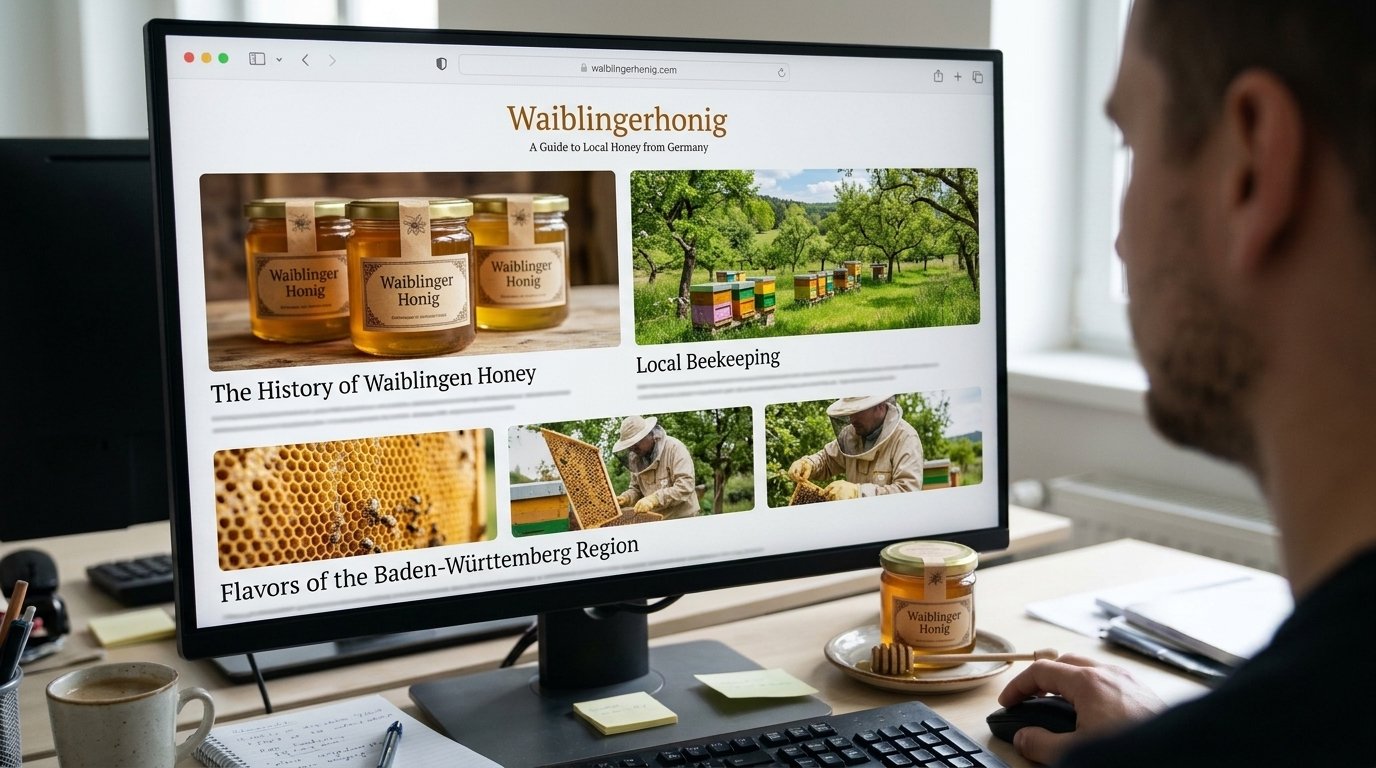
Waiblingerhonig refers to honey associated with Waiblingen, a town in Baden-Württemberg, southwestern Germany. The name connects a familiar natural food with a specific regional identity, local beekeeping traditions, and the landscapes where honeybees gather nectar and honeydew. For readers in the United States, understanding Waiblingerhonig offers a useful introduction to regional German honey and the factors that shape its flavor, quality, and origin.
Unlike a standardized floral variety such as clover honey, Waiblingerhonig is best understood as a geographic and regional product designation. Its exact characteristics depend on the producer, the location of the bee colonies, the flowering season, and the plants available to the bees.
Whether you are interested in German food culture, local honey, traditional beekeeping, or finding a distinctive food gift, learning about Waiblingerhonig starts with understanding the place behind the name.
What Is Waiblingerhonig?
Waiblingerhonig is the German expression commonly used for honey associated with Waiblingen. The word combines Waiblinger, meaning associated with Waiblingen, and Honig, the German word for honey.
The name does not, by itself, establish a single floral source, a particular flavor profile, or a universal production method. Those characteristics must be determined from the specific product and its producer.
Waiblingen is located in Baden-Württemberg, near Stuttgart, in the Rems Valley region known as the Remstal. The surrounding area includes settlements, gardens, agricultural land, orchards, and other landscapes that can provide flowering plants for honeybees.
Regional honey reflects the interaction between these local environments and the work of beekeepers. Depending on the season and available plants, a jar may contain honey derived from a mixture of floral sources or, when the relevant conditions and production requirements are met, a more specifically identified honey variety.
For consumers, the most important distinction is between a honey’s regional association and its verified place of production. A product marketed with a regional name should be evaluated using its label and the producer’s information rather than its name alone.
Where Does Waiblingerhonig Come From?
Waiblingerhonig is associated with Waiblingen, a town in southwestern Germany. Understanding its regional setting helps explain why local honey can differ from products harvested in other places.
Waiblingen and the Remstal landscape
Waiblingen sits in Baden-Württemberg, a region with a mixture of urban communities, gardens, orchards, farmland, and wooded areas. This variety of environments can offer honeybees access to different flowering plants throughout the year.
The precise plants available to a colony depend on its location, the weather, the time of year, and the surrounding land use. Consequently, not every honey produced in the area will have the same color, aroma, sweetness, or texture.
Fruit-tree blossoms may contribute to some spring harvests, while other flowering plants can contribute nectar later in the season. Honeydew collected from certain trees may also contribute to honey production where conditions allow.
These are possible sources, not a guaranteed ingredient list for every jar of Waiblingerhonig.
The role of local beekeepers
Beekeepers manage colonies, monitor their condition, provide suitable hive environments, and harvest honey when it is ready. They also have to account for seasonal weather, food availability, and the health of their colonies.
Local beekeeping organizations in Waiblingen support public education about honeybees, pollination, honey production, and the importance of suitable habitats for pollinating insects.
This educational work helps connect consumers with the agricultural and ecological processes behind a jar of honey.
Does all Waiblingerhonig come from Waiblingen?
The name alone should not be treated as conclusive proof that every drop was produced within the town’s boundaries.
A seller may operate in Waiblingen while sourcing honey from another location. Similarly, a regional product may be associated with a broader surrounding area rather than one exact address.
If the precise origin matters to you, look for the stated country of origin and any more specific geographical information on the label. Ask the producer where the bee colonies were kept and where the honey was harvested.
How Is Waiblingerhonig Produced?
The production of local honey follows the natural activity of honeybees and the work of beekeepers. Although individual practices vary, the process generally involves collecting nectar or honeydew, transforming it inside the hive, allowing it to mature, and harvesting it when appropriate.
1. Honeybees collect nectar and honeydew
Worker bees visit flowering plants to collect nectar, a sugary liquid produced by flowers. Depending on the environment and conditions, honeybees may also collect honeydew, a sugary substance associated with certain plant-feeding insects.
The available food sources influence the composition and eventual character of the honey.
2. Bees transform the collected material
Inside the hive, bees transfer the collected material, process it with the help of enzymes, and reduce its moisture content. They store it in honeycomb cells as it matures.
When the honey is sufficiently mature, bees commonly seal the cells with wax.
3. The beekeeper harvests the honey
The beekeeper removes suitable honeycomb frames or other harvestable honey stores while taking care to manage the colony’s needs.
In many conventional harvesting systems, honey is extracted from the comb using equipment that separates the honey from the wax structure. Other products, such as comb honey, retain the honeycomb itself.
4. The honey is prepared for sale
Depending on the producer’s methods, the harvested honey may be strained to remove wax particles and other coarse material, allowed to settle, and packed into jars.
Heating, fine filtration, blending, and other processing choices can affect the final product. Buyers who prefer minimally processed honey can ask the producer which methods are used.
The exact production method for a particular jar of Waiblingerhonig should be confirmed with its producer rather than assumed from its regional name.
What Does Waiblingerhonig Taste Like?
There is no single flavor that reliably describes every honey associated with Waiblingen. Honey’s taste, color, aroma, and texture depend heavily on the plants visited by the bees, the proportions of different nectar or honeydew sources, and the conditions under which the honey was produced and stored.
A honey containing substantial contributions from certain spring blossoms may taste relatively mild and delicate. Honey with contributions from stronger-flavored flowering plants can have a more pronounced aroma. Honeydew-based forest honey is often darker and more robust than many blossom honeys.
These are general characteristics of honey types, not guaranteed tasting notes for a specific Waiblingerhonig product.
Common characteristics to compare
- Color: Honey can range from nearly white or pale gold to amber and dark brown.
- Sweetness: All ordinary honey is sweet, but perceived sweetness can vary with its composition and accompanying aromas.
- Aroma: Some honeys have delicate floral notes, while others smell more herbal, fruity, or woody.
- Texture: Honey may be fluid, creamy, thick, or crystallized.
- Aftertaste: The finish can be mild, floral, or more pronounced, depending on its botanical composition.
The most useful way to assess a particular honey is to examine its label and sample it when possible. Flavor descriptions should be treated as product-specific rather than universal characteristics of the regional name.
What Types of Honey Might Be Associated With Waiblingen?
Regional beekeepers may produce different kinds of honey depending on the flowering plants and other food sources available to their colonies. The following categories explain what to look for, but they should not be interpreted as a confirmed inventory of every Waiblingerhonig producer.
| Honey type | Typical characteristics | What to know |
|---|---|---|
| Blossom honey | Varies from mild and delicate to aromatic | Usually reflects nectar from multiple flowering plants unless more specifically identified |
| Spring honey | Often light in color and mild, depending on its floral sources | May include contributions from fruit blossoms and other early-season plants |
| Summer honey | Can have a more developed or varied aroma | Its character depends on the plants flowering during the harvest period |
| Forest honey | Often darker, with a more pronounced flavor | Typically associated with honeydew rather than exclusively with flower nectar |
| Creamed honey | Smooth, spreadable texture | Made by controlling crystallization rather than creating an entirely different botanical variety |
A producer may sell one or several of these types, and the selection can change from year to year. Weather, flowering conditions, and the needs of the bee colonies all influence the quantity and type of honey available.
Why can two jars from the same area taste different?
Even nearby bee colonies do not necessarily collect nectar from identical sources. Bees forage over a surrounding area, and the availability of flowers changes as plants bloom and weather conditions shift.
One harvest may contain more contributions from early-flowering plants, while another may reflect later blossoms or honeydew. Differences in moisture content, crystallization, handling, and storage can also affect the sensory experience.
For that reason, variation between harvests is a normal feature of many natural honeys. It does not automatically indicate that one jar is inferior to another.
What Makes Local Honey Different From Supermarket Honey?
Local honey and supermarket honey are not necessarily different in nutritional value or quality simply because of where they are sold. The meaningful differences relate to verified origin, production methods, traceability, processing, and the particular product.
Locally produced honey may allow consumers to learn more directly about the beekeeper, the harvest location, and the way the honey was handled. Larger commercial products may use honey from multiple sources to maintain a more consistent product from one batch to another.
Neither approach automatically guarantees superior quality. A carefully produced commercial honey can be excellent, and a local honey still needs appropriate handling and trustworthy labeling.
Local honey versus mass-market honey
| Consideration | Locally produced honey | Mass-market honey |
|---|---|---|
| Origin | May provide more specific information about the apiary and harvest | May combine honey from multiple production areas |
| Flavor | Can vary with local flowers and seasonal conditions | May be blended to maintain a consistent taste |
| Producer information | Direct communication may be possible | Information is generally provided through the product label and seller |
| Availability | Can be seasonal or limited | Often available throughout the year |
| Processing | Depends on the individual beekeeper | Depends on the brand and product |
| Price | Varies by producer, harvest, and packaging | Varies by brand, source, and retail channel |
The best choice depends on your priorities. If knowing where the honey was produced matters to you, detailed origin information and producer transparency are more useful than a generic claim that a product is natural or premium.
How to Identify Authentic Regional Honey
If you want to buy Waiblingerhonig because of its connection to Waiblingen, verify the product’s origin rather than relying solely on branding.
Check the country of origin
Look for the stated origin of the honey. A producer’s business address is not necessarily the place where the bees produced it.
A jar packaged in Germany may contain honey from another country. Likewise, a German retailer or local business may sell imported honey alongside locally harvested products.
Look for more specific regional information
A label that identifies the production area, beekeeper, or harvest can provide useful context. The more specific the information, the easier it may be to understand the product’s provenance.
However, a local address or attractive regional label should not be treated as independent proof of the honey’s exact origin.
Ask the producer direct questions
If the jar does not provide enough information, consider asking:
- Where were the bee colonies located during this harvest?
- Was the honey harvested locally or sourced from another producer?
- Is it blossom honey, honeydew honey, or a specifically identified variety?
- Was the honey blended with honey from other locations?
- How was it extracted and processed before bottling?
A transparent producer should be able to explain the product’s origin and general production methods.
Understand what quality labels mean
Honey labels may contain product names, origin statements, net weight, a best-before date, and information identifying the responsible producer or business. Specific labeling requirements depend on the applicable rules and market.
Some quality marks also impose standards beyond basic legal requirements. Before interpreting a label, check what the particular mark actually certifies.
Avoid assuming that words such as “natural,” “traditional,” “premium,” or “local” prove that a honey has a specific floral composition or superior nutritional properties.
Where Can You Buy Waiblingerhonig?
Waiblingerhonig may be available through local honey sellers, beekeepers, regional food retailers, and selected tourist-information outlets in or around Waiblingen. Availability can change according to the harvest, season, and seller.
For visitors, checking the current local tourism information is a practical starting point. Waiblingen’s official tourist information has listed honey among its regional souvenir products. This is useful evidence of local availability, although it does not establish that every variety or batch is continuously in stock.
Buy directly from a local beekeeper
Purchasing directly from a beekeeper can make it easier to ask about the harvest, botanical sources, processing, and storage.
When considering direct sales, confirm opening arrangements before visiting. Small beekeeping operations may sell by appointment rather than maintain regular retail hours.
Check local markets and regional food shops
Farmers’ markets and specialty food retailers can offer another way to discover regional honey. Ask whether the honey was produced in Waiblingen itself, in the surrounding Remstal, or elsewhere.
This distinction is especially important if you want a product tied to one particular location.
Consider honey as a regional gift
A jar of locally produced honey can be a practical food gift for someone interested in German regional products. Packaging, jar size, harvest information, and a clear description of the origin can make the gift more meaningful.
For international travel, check the destination country’s current rules for bringing honey and other agricultural products across the border. Requirements can differ by destination and traveler circumstances.
What should you expect to pay?
There is no single reliable price for Waiblingerhonig. The cost depends on jar size, harvest quantity, the honey variety, production and packaging choices, and the seller.
Compare prices using the same unit of weight, such as price per 100 grams, rather than comparing jars of different sizes. Also consider whether the product provides the regional origin and producer information you value.
If a particular price is advertised, confirm that it applies to the exact jar and current stock before traveling to buy it.
Is Waiblingerhonig Organic?
The regional name alone does not establish that a honey is certified organic.
Organic status depends on the applicable certification system and its requirements. A product may be locally produced without being certified organic, while a certified product may come from another region.
Honey production also differs from growing a crop on a conventional farm. Honeybees forage across surrounding areas, so the production environment and the rules governing certification matter.
If organic certification is important to you, look for a valid certification mark and the required accompanying information. Ask the producer about certification if the label is unclear.
Do not interpret the words “local,” “pure,” “natural,” and “organic” as interchangeable. They describe different attributes.
Is Waiblingerhonig Healthy?
Honey is a food containing naturally occurring sugars and small amounts of other constituents. Its nutritional profile varies, but it should still be treated primarily as a sweetener rather than as a medical treatment.
Honey can be enjoyed in ordinary meals and drinks, but claims that a particular regional honey prevents disease, treats allergies, or delivers unique medicinal benefits require appropriate evidence. The name Waiblingerhonig does not establish any special therapeutic effect.
Nutritional considerations
Like other honey, Waiblingerhonig contributes sugars and calories to the diet. The amount depends on the serving size and the specific product.
You can use it to sweeten tea, yogurt, oatmeal, sauces, or baked goods. However, honey is not nutritionally equivalent to an unsweetened food, and adding it still increases the amount of sugar consumed.
People managing blood glucose should consider honey as part of their overall carbohydrate intake and follow the advice of their healthcare professional when needed.
An important safety precaution
Honey should never be given to infants younger than 12 months because of the risk of infant botulism. This precaution applies to local, imported, raw, and pasteurized honey alike.
For other consumers, a regional origin or a claim that honey is minimally processed should not be interpreted as proof that it is suitable for every medical or dietary circumstance.
How to Store Waiblingerhonig Properly
Proper storage helps preserve honey’s flavor, aroma, and usability.
Follow these practical guidelines:
- Keep the jar tightly closed. Honey can absorb moisture and odors from its surroundings.
- Store it in a cool, dry place. A cupboard away from direct sunlight and strong heat is generally suitable.
- Use a clean, dry utensil. Introducing water or food residue can affect the honey’s quality.
- Avoid unnecessary heating. Excessive heat can change the honey’s aroma and other characteristics.
- Check the producer’s label. Follow any product-specific storage instructions.
Why does honey crystallize?
Crystallization occurs when glucose in honey forms crystals. It is a natural process, and its speed depends on factors such as the honey’s sugar composition, temperature, and the presence of tiny particles that help crystals form.
Some honeys crystallize quickly, while others remain fluid longer. Crystallization alone does not mean that honey has spoiled or that sugar has been added.
If you prefer liquid honey, place the closed jar in warm water and allow it to soften gradually. Avoid boiling water and prolonged high heat, especially if preserving the honey’s original aroma is important.
If honey develops an unusual smell, signs of fermentation, or other unexpected changes, do not assume that crystallization explains them. Assess the product carefully and contact the producer if necessary.
Waiblingerhonig and the Environment
Honey production connects food, land use, and the lives of pollinating insects. Honeybees visit flowers to collect food, and in doing so they can transfer pollen between flowers, supporting pollination for many plants.
The availability of flowering plants is therefore important to managed honeybee colonies and other pollinators.
Why flowering habitats matter
Gardens, orchards, flowering field margins, and suitable green spaces can provide food at different times of the year. A varied supply of flowers helps reduce periods when pollinators have limited access to nectar and pollen.
Planting a range of locally appropriate flowering species and avoiding unnecessary disturbance of nesting and feeding habitats can contribute to a more supportive environment for pollinating insects.
Honeybees are only one part of that environment. Wild bees, butterflies, hoverflies, and other insects also play important ecological roles.
Does buying local honey automatically help the environment?
Not necessarily. Buying locally may shorten some distribution routes and create opportunities to learn about production practices, but the environmental impact of a product depends on more than distance alone.
Colony management, land use, packaging, transport, and the condition of local habitats all matter. A local label does not automatically certify that a product is organic, carbon-neutral, or produced under a particular animal-welfare or environmental standard.
Consumers who care about sustainability can ask beekeepers about their practices and look for specific, verifiable information rather than relying on broad environmental claims.
How to Enjoy Waiblingerhonig at Home
The best way to enjoy a particular honey is to choose uses that complement its flavor. A mild honey can suit delicate foods, while a more aromatic honey may work well in recipes with stronger ingredients.
Here are several practical ideas.
Breakfast and everyday meals
Drizzle honey over plain yogurt, oatmeal, or fresh fruit. Add a small amount to whole-grain toast or use it to sweeten a homemade breakfast dressing.
If you are comparing different honey varieties, taste a small amount on its own first. This makes it easier to notice differences in aroma and texture.
Tea and warm drinks
Honey can sweeten tea and other drinks. Let a very hot drink cool slightly before adding the honey if you want to preserve more of its delicate aroma.
The flavor of the drink will influence how strongly you notice the honey’s own characteristics.
Salad dressings and marinades
A small amount of honey can balance acidic ingredients such as vinegar or lemon juice in a salad dressing. It can also contribute sweetness to marinades for vegetables or other foods.
Because honey browns during cooking, recipes that use it for glazing may need closer temperature control to avoid excessive darkening.
Baking and desserts
Honey can be used in selected cakes, cookies, granola, and dessert recipes. It contributes moisture and sweetness, so substituting it for granulated sugar may require adjustments to the liquid and baking time.
Use a recipe designed for honey or one that provides tested substitution guidance rather than assuming a one-to-one replacement will always work.
A simple tasting comparison
If you have access to two or three honey varieties, compare them side by side.
- Place a small amount of each honey in a separate clean spoon or dish.
- Observe the color and texture.
- Smell each sample before tasting.
- Taste a small amount and notice the sweetness, aroma, and finish.
- Record which variety you prefer and what foods you think would complement it.
This is a simple way to explore how floral sources and production conditions can shape honey without assuming that one variety is objectively best.
What to Know Before Buying Waiblingerhonig
Before purchasing a jar, use this checklist to determine whether it meets your expectations.
- Origin: Is the honey actually produced in Waiblingen or the surrounding region?
- Producer: Can you identify the beekeeper or responsible business?
- Honey type: Is the product described as blossom, forest, spring, summer, or another variety?
- Processing: Does the producer explain whether the honey is extracted, strained, blended, or otherwise processed?
- Label: Are the product identity, weight, origin information, and relevant dates or identification details clear?
- Price: Is the cost reasonable for the jar size and product characteristics?
- Availability: Has the seller confirmed that the specific honey is currently in stock?
- Storage: Is the jar properly closed and free from obvious signs of damage or contamination?
You do not need to find a product that meets every personal preference. The goal is to understand what you are buying and distinguish verified information from marketing language.
Frequently Asked Questions About Waiblingerhonig
What does Waiblingerhonig mean in English?
Waiblingerhonig means honey associated with Waiblingen, a town in Baden-Württemberg, Germany. The word combines the regional adjective Waiblinger with Honig, the German word for honey.
Is Waiblingerhonig a specific type of honey?
Not necessarily. The name identifies a regional association rather than one universally defined floral variety. The actual honey may differ in color, taste, aroma, and texture according to its source plants, harvest, and production methods.
Where can I buy Waiblingerhonig?
Potential places include local beekeepers, regional food retailers, markets, and Waiblingen’s tourist-information outlets. Availability can vary, so confirm the origin, current stock, and opening arrangements with the seller before visiting.
Is Waiblingerhonig produced in Germany?
The name associates the honey with Waiblingen in Germany, but the name alone is not sufficient proof of a specific jar’s production origin. Check the product label and ask the producer where the honey was harvested.
Is Waiblingerhonig organic?
The regional name does not establish organic certification. Look for the relevant certification information if organic production is important to you.
Why does Waiblingerhonig sometimes become solid?
Honey naturally crystallizes when glucose forms crystals. The speed depends on its composition, temperature, and other factors. Crystallization is generally a normal physical change and does not, by itself, mean the honey has spoiled.
Is local honey better than supermarket honey?
Neither is automatically better. Local honey may offer more specific producer information and a distinct seasonal flavor, while supermarket honey may offer consistent availability. Origin, handling, processing, and transparent labeling are more useful quality indicators than the sales channel alone.
Can Waiblingerhonig help with seasonal allergies?
There is insufficient basis to recommend Waiblingerhonig as a reliable treatment for seasonal allergies. Honey’s floral composition varies, and the regional name does not establish a therapeutic benefit. Anyone seeking allergy treatment should consult an appropriate healthcare professional.
How should Waiblingerhonig be stored?
Keep the jar tightly closed in a cool, dry place away from direct sunlight and strong odors. Use a clean, dry utensil and follow any additional storage instructions on the label.
Is Waiblingerhonig suitable as a gift?
It can be a thoughtful regional food gift for someone interested in German products or beekeeping. Choose a jar with clear origin information and suitable packaging, and check applicable food-import rules if the recipient lives in another country.
Conclusion
Waiblingerhonig offers a way to explore the connection between regional identity, beekeeping, and the natural variation found in honey. Associated with Waiblingen in Baden-Württemberg, Germany, it belongs to a broader tradition of local food production in which the surrounding landscape and seasonal flowering conditions influence the harvest.
The key to understanding this honey is to look beyond its name. Its flavor, botanical composition, processing, and exact origin depend on the individual product and producer. Clear labeling and direct questions can help consumers determine whether a jar matches their expectations.
For readers in the United States, learning about Waiblingerhonig also provides a useful perspective on how regional foods reflect their places of origin. Whether enjoyed with breakfast, used in cooking, or selected as a gift, the most meaningful choice is a honey whose origin and characteristics are explained honestly.
Explore more: English in en slovakia : What Visitors Need to Know



1 response