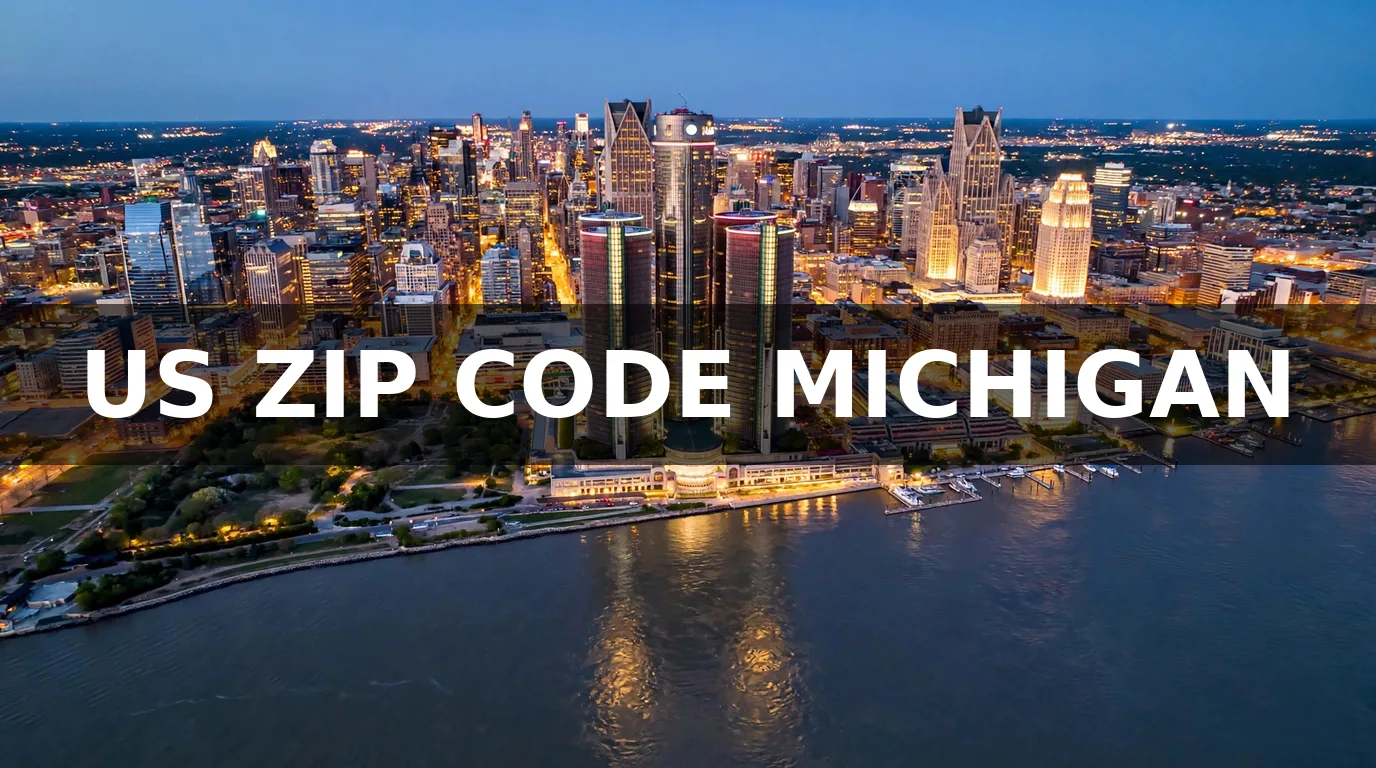
If you need a US ZIP code in Michigan, here is the short answer: every Michigan ZIP code falls between 48000 and 49999. Detroit’s downtown ZIP code is 48201, Grand Rapids is 49503, and Ann Arbor is 48104. The rest of this guide lists the main ZIP code for every major Michigan city, explains how the numbers are organised across the state, and shows you the fastest ways to look up any code you cannot find here.
Michigan is a big state with two peninsulas and hundreds of towns and cities, so a single list can never cover every code. What it can do is give you the right starting point and a reliable method for the rest.
How Michigan ZIP Codes Are Organised
ZIP codes in the United States are built from left to right, and each digit narrows the area down. The first digit stands for a broad region of the country. Michigan’s first digit is 4, which covers the Great Lakes region, including Ohio, Indiana, and Illinois. The next two digits narrow it to a sectional centre, which is roughly a cluster of post offices around a city. The last two digits point to a specific post office or delivery area.
That is why Michigan’s codes run from 48000 to 49999. The 48000s and most of the 48100s to 48900s belong to the Lower Peninsula, while the 49000s cover the southwest and west of the state, and the 49600s through 49900s cover northern Michigan and the Upper Peninsula. A code starting with 48 usually means southeast or central Michigan. A code starting with 49 usually means western, northern, or Upper Peninsula Michigan. It is a rough guide rather than a strict rule, but it is a handy one: if someone gives you a code starting with 498, you already know you are dealing with the Upper Peninsula, and if it starts with 482, you are in Detroit.
It also helps to know what a ZIP code is not. A ZIP code is a mail delivery area, not a city boundary. That is the single most common source of confusion, and it explains almost every odd result you will run into. A city can have several ZIP codes, and a single ZIP code can cover parts of two or three different towns. Detroit, for example, has dozens of ZIP codes, from 48201 downtown to 48228 on the west side and 48234 on the northeast side.
Major Michigan Cities and Their Main ZIP Codes
The table below gives the main ZIP code for each of Michigan’s largest cities. “Main” means the best-known or most central code for that city — the one people usually mean when they ask for the city’s ZIP code. Bigger cities have many more codes, so if the one listed here does not match the address you have, you will need the street-level lookup explained later in this guide.
| City | Main ZIP Code | County |
|---|---|---|
| Detroit | 48201 | Wayne |
| Grand Rapids | 49503 | Kent |
| Ann Arbor | 48104 | Washtenaw |
| Lansing | 48933 | Ingham |
| Flint | 48502 | Genesee |
| Kalamazoo | 49007 | Kalamazoo |
| Warren | 48089 | Macomb |
| Sterling Heights | 48310 | Macomb |
| Dearborn | 48126 | Wayne |
| Saginaw | 48601 | Saginaw |
| Traverse City | 49684 | Grand Traverse |
| Troy | 48084 | Oakland |
| Livonia | 48150 | Wayne |
| Royal Oak | 48067 | Oakland |
| East Lansing | 48823 | Ingham |
| Jackson | 49201 | Jackson |
| Battle Creek | 49015 | Calhoun |
| Muskegon | 49440 | Muskegon |
| Holland | 49423 | Ottawa |
| Bay City | 48706 | Bay |
| Midland | 48640 | Midland |
| Port Huron | 48060 | St. Clair |
| Ypsilanti | 48197 | Washtenaw |
| Marquette | 49855 | Marquette |
| Houghton | 49931 | Houghton |
A few notes on the table are worth keeping in mind. First, the county column tells you which county the city sits in, which matters because some Michigan cities cross county lines. Lansing, for instance, is mostly in Ingham County but extends into Eaton and Clinton counties. If a form asks for a county rather than a city, the county of the specific address matters, not the county of the city centre.
Second, several of these cities are close enough together that their ZIP codes can be easy to mix up. Dearborn (48126) and Livonia (48150) are both in Wayne County and both start with 481, but they are different cities with different post offices. Warren (48089) and Sterling Heights (48310) sit side by side in Macomb County, yet their codes are far apart numerically. The numbers are assigned by postal geography, not by how close two places are on a map, so never guess a code by copying a neighbour’s.
Third, university towns deserve a special mention. Ann Arbor’s 48104 covers the University of Michigan’s central campus and downtown, while East Lansing’s 48823 covers Michigan State University. If you are sending something to a student or a campus building, the street address matters more than the city code, because campuses often have their own ZIP+4 codes for individual buildings.
How to Find Any Michigan ZIP Code
If your city or town is not in the table above, or you need the code for a specific street address, here are the methods that actually work, in order of reliability.
Use the USPS ZIP Code Lookup
The most reliable way to find a Michigan ZIP code is the United States Postal Service’s own lookup tool. You type in a street address, city, and state, and it returns the correct five-digit ZIP code and the ZIP+4. This is the same database the post office itself uses, so it is the final word when two sources disagree. It is free, it needs no account, and it works for every deliverable address in the country.
Search by City and State
If you only know the name of a town and not a street address, a simple search for the town name followed by “Michigan ZIP code” will usually give you the answer in the first result. This works well for towns with a single ZIP code, which is most small towns in Michigan. It works less well for larger places, because the search result will normally show only the main code, not the one for the neighbourhood you actually need.
Use the Address on the Envelope or Package
It sounds obvious, but the best source for a ZIP code is often the mail itself. If you have received a letter, a bill, or a package from the person or business you are writing to, the return address on it carries the correct ZIP code. The same goes for a business card, an invoice, or a company website’s contact page. When the address on the envelope and the address in your contacts disagree, trust the envelope — it is the version that has already been delivered successfully.
Ask for the ZIP+4 When It Matters
For most everyday purposes — a form, a greeting card, an online order — the five-digit ZIP code is enough. But if you are sending something to a large building, a business park, a university, or a government office, the nine-digit ZIP+4 can make the difference between a delivery that arrives on time and one that bounces around for an extra day. The ZIP+4 narrows the delivery down to a specific building, a floor, or a block of addresses, and it is worth including whenever you have it.
What Is ZIP+4 and Do You Need It?
A ZIP+4 code is the familiar five-digit ZIP code with four extra digits added after a hyphen, like 48201-1234. The extra four digits identify a much smaller delivery area: a specific side of a street, a single building, or even a single floor of a large building. The Postal Service introduced ZIP+4 in the early 1980s to speed up sorting, and it has been part of the system ever since.
For most people, the short answer is that you do not need ZIP+4. The five-digit code is enough for the post office to deliver your mail, and most forms do not ask for the extra digits. But there are situations where it helps. If you run a business that sends a lot of mail, using ZIP+4 can qualify you for postage discounts and faster processing. If you are sending something to a large organisation with many departments, the extra digits route it to the right building instead of a central mailroom.
Finding a ZIP+4 is easy: the USPS lookup tool returns it automatically when you enter a full street address. You do not need to memorise it, and you do not need to guess it — guessing the last four digits is worse than leaving them off, because a wrong ZIP+4 can send mail to the wrong building. Either look it up properly or stick with the five-digit code.
Michigan ZIP Codes by Region
Michigan’s two peninsulas and its spread-out population mean the state’s ZIP codes cluster into clear regional groups. Knowing which group an area belongs to helps you spot a wrong code at a glance.
Southeast Michigan
Southeast Michigan is the most densely coded part of the state, which makes sense: it holds Detroit, the suburbs of Wayne, Oakland, and Macomb counties, and the cities of Ann Arbor and Ypsilanti. Codes here mostly start with 480, 481, 482, 483, 484, and 485. Detroit’s codes run through the 48200s, the inner suburbs use the 48000s and 48300s, and Ann Arbor and Ypsilanti sit in the 48100s. Flint, in Genesee County, uses the 48500s, and Port Huron, on the St. Clair River at the Canadian border, uses the 48000s.
West Michigan
West Michigan runs along the Lake Michigan shoreline and inland toward the centre of the state, and its codes mostly start with 490, 493, 494, and 495. Grand Rapids, the region’s largest city, uses the 49500s, with 49503 covering the downtown area. Kalamazoo uses the 49000s, Battle Creek the 49000s as well, and the lakeshore cities of Muskegon and Holland use the 49400s.
Central Michigan
Central Michigan covers the state capital and the cities around it. Lansing uses the 48900s, with 48933 as its main code, and East Lansing uses 48823. Saginaw, Bay City, and Midland — the three cities of the Tri-Cities area — use the 48600s and 48700s, and Jackson, in the south-central part of the state, uses the 49200s. The region is less densely coded than the southeast, so individual towns are more likely to have a single ZIP code, and a city-name search is more likely to give you the right answer on the first try.
Northern Michigan and the Upper Peninsula
Northern Michigan and the Upper Peninsula use the highest numbers in the state’s range, from 49600 up to 49999. Traverse City, the largest city in the northern Lower Peninsula, is 49684. Marquette, the largest city in the Upper Peninsula, is 49855, and Houghton, at the far western end of the Upper Peninsula, is 49931 — one of the highest ZIP codes in the state. These areas have the lowest population density in Michigan, which means ZIP codes cover much larger areas here than they do downstate. A single code in the Upper Peninsula can cover a whole township and the small communities inside it, so the city name attached to a code is often the name of the post office rather than the name of the place where the address actually sits.
Common Mistakes When Using Michigan ZIP Codes
A handful of mistakes account for most of the ZIP code problems people run into with Michigan addresses, and all of them are easy to avoid once you know what to watch for.
The first is using a neighbouring city’s code. This happens most often in Metro Detroit, where suburbs run into each other without any visible break. Someone who lives in Royal Oak might use a Birmingham code because their street is near the border, or someone in Warren might use a Sterling Heights code because the two cities share a long boundary. The post office does not care how close you are to the border — it cares which side of it your mailbox sits on. When in doubt, look it up by street address.
The second mistake is confusing a ZIP code with an area code. Michigan’s area codes — 313 for Detroit, 616 for Grand Rapids, 734 for Ann Arbor, 517 for Lansing, 906 for the Upper Peninsula — look nothing like ZIP codes, but people still mix them up when they are filling out a form quickly. If the number you are about to enter starts with 906, that is a phone area code for the Upper Peninsula, not a ZIP code. Michigan ZIP codes always start with 48 or 49.
The third mistake is assuming the ZIP code matches the city limits. As noted earlier, a ZIP code is a mail route, not a municipal boundary. This matters most when a form asks for both a city and a ZIP code and the two do not match in the way you expect — for example, an address in a township that uses a neighbouring city’s name and ZIP code for mail. In that case, use the mailing city and ZIP code the post office recognises, even if your local government calls the place something else.
The fourth mistake is trusting an old list. ZIP codes change when post offices close, when new neighbourhoods are built, and when delivery routes are reorganised. A list printed years ago, or a website that has not been updated, can quietly carry codes that no longer exist. The USPS lookup is the only source that is always current, so check there before sending anything important to an address you have not used in a while.
Frequently Asked Questions About Michigan ZIP Codes
What is the ZIP code for Detroit, Michigan?
Detroit’s main downtown ZIP code is 48201, but Detroit has dozens of ZIP codes covering different neighbourhoods. The correct code depends on the street address — for example, 48226 covers part of downtown, 48228 covers the west side, and 48234 covers the northeast side. If you need the code for a specific Detroit address, look it up by street address rather than by city name.
What is the ZIP code for Grand Rapids, Michigan?
Grand Rapids’ main ZIP code is 49503, which covers the downtown area. Like Detroit, Grand Rapids has many ZIP codes, and the right one depends on the neighbourhood. The 49500s cover the city and its nearby suburbs, with different codes for the northeast, southeast, and southwest sides of town.
What range do Michigan ZIP codes fall in?
All Michigan ZIP codes fall between 48000 and 49999. The 48000s through the 48900s generally cover the Lower Peninsula, while the 49000s cover the southwest and west, and the 49600s through 49900s cover northern Michigan and the Upper Peninsula.
How do I find a ZIP code for a small town in Michigan?
Most small towns in Michigan have a single ZIP code, so a search for the town name plus “Michigan ZIP code” usually gives you the answer straight away. If the town is very small, it may share a ZIP code with a larger nearby town — in that case, the search result will show the larger town’s name, and that is the correct code to use for mailing purposes.
What is the ZIP code for the Upper Peninsula?
There is no single ZIP code for the Upper Peninsula, because the region covers a large area with many towns. Its codes run from 49800 to 49999. Marquette, the largest city in the Upper Peninsula, is 49855, and Houghton, at the western end, is 49931. If you know the town name, look it up directly; if you only know the county, a county-level search will narrow it down.
Can two different cities share the same ZIP code?
Yes. A single ZIP code can cover parts of more than one town, especially in rural areas where one post office serves several small communities. The reverse is also true: a large city can have many ZIP codes. That is why the street address, not the city name, is the most reliable way to find the right code.
Conclusion
Finding a US ZIP code in Michigan is straightforward once you know the shape of the system: every code in the state runs from 48000 to 49999, the big cities each have a well-known main code, and the USPS lookup tool settles any address the table does not cover. Detroit is 48201, Grand Rapids is 49503, Ann Arbor is 48104, and the rest of the state’s cities follow the same pattern — one main code for the centre, and more codes for the neighbourhoods around it.
The two habits that will save you the most trouble are looking codes up by full street address instead of by city name, and double-checking any code you have not used in a while. ZIP codes are mail routes, not city boundaries, and they change more often than most people realise. Get those two things right, and the Michigan ZIP code you need will be the one that actually gets your mail delivered.
Read Also: T Pain Songs List: The Best Hits and Features Ever