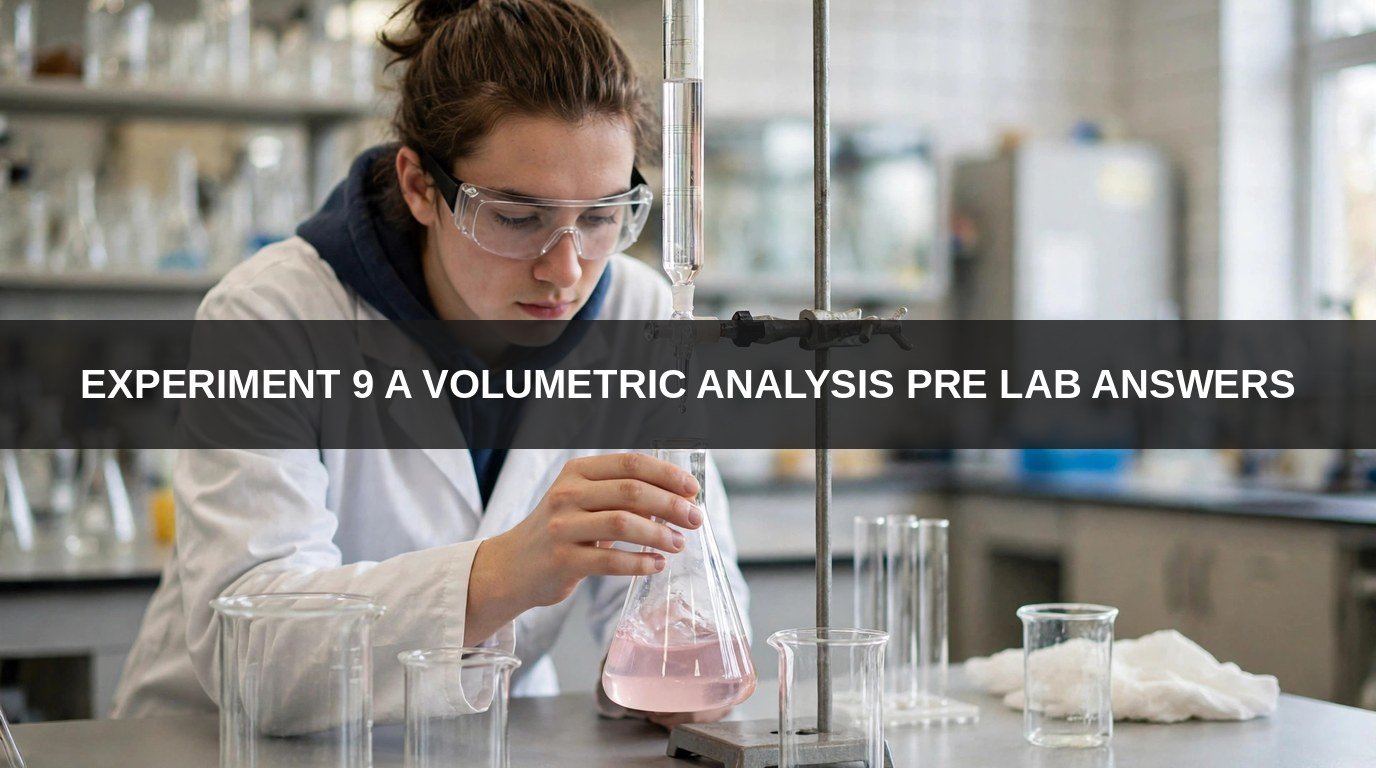
Experiment 9, “A Volumetric Analysis,” is the titration lab that shows up in almost every first-year chemistry course — and its pre-lab assignment is where students lose easy marks, not because the ideas are hard, but because the vocabulary is precise and the one calculation question has nowhere to hide. If you can define a handful of terms correctly, explain why the buret gets rinsed with titrant instead of water, and work a mole calculation without fumbling the units, you’re ready.
This page covers the whole assignment properly: what the experiment is for, the core concepts in plain language, the standard pre-lab questions with explained answers rather than one-line memorizations, a fully worked standardization calculation, the procedure, the safety points, and the mistakes that quietly wreck results.
What Experiment 9 Is About
Volumetric analysis means finding the concentration of a solution by measuring volume — specifically, the volume of a second solution that reacts with it completely. In Experiment 9 you do this in two stages:
- Part A — Standardization. You prepare a sodium hydroxide (NaOH) solution of roughly known concentration, then find its exact concentration by titrating it against a precisely weighed solid acid, potassium hydrogen phthalate (KHP).
- Part B — Analysis of an unknown. You use your now-standardized NaOH to titrate a measured volume of an acid solution of unknown concentration, and calculate that concentration from the volume of NaOH required.
The whole experiment hangs on one idea: at the exact moment the reaction is complete, the moles of the two reactants match the ratio in the balanced equation. Measure one volume accurately, know one concentration accurately, and the unknown falls out of the arithmetic. The pre-lab is testing whether you understand the pieces of that sentence.
The Core Concepts, in Plain Language
| Term | What it means |
|---|---|
| Titrant | The solution delivered from the buret, added gradually during the titration. In Experiment 9, the titrant is the NaOH solution. |
| Analyte | The substance being analyzed — the solution in the flask whose concentration (or amount) you are determining. In Part A the analyte is KHP; in Part B it is the unknown acid. |
| Standard solution | A solution whose concentration is known accurately. Accuracy is the whole point — every result in the experiment traces back to it. |
| Primary standard | A substance pure and stable enough that its concentration can be established simply by weighing it. KHP is the primary standard here. |
| Secondary standard | A solution whose concentration is found by titrating it against a primary standard. Your NaOH becomes a secondary standard once Part A is done. |
| Molarity (M) | Moles of solute per liter of solution: M = mol ÷ L. Every calculation in this lab is a rearrangement of this one relationship. |
| Equivalence (stoichiometric) point | The theoretical point where moles of titrant exactly equal the moles required by the balanced equation — nothing left over on either side. |
| End point | The experimental signal that tells you to stop: the indicator’s color change. It happens in the flask, where you can see it; the equivalence point happens in the math. |
| Indicator | A dye that changes color over a specific pH range. Phenolphthalein is used here — colorless in acid, pink in base. |
The distinction students most often blur is equivalence point versus end point. The equivalence point is exact and invisible; the end point is the indicator’s best attempt to announce it. The small gap between them is the titration error, and good technique — a well-chosen indicator, dropwise addition near the end — exists to keep it tiny.
Why the NaOH Has to Be Standardized at All
Students reasonably ask why they can’t just weigh out NaOH pellets, dissolve them, and declare the concentration. Two problems prevent it. First, solid NaOH is hygroscopic: it pulls water vapor out of the air while it sits on the balance, so the mass you record is part NaOH, part absorbed water, in unknown proportions. Second, NaOH solutions absorb carbon dioxide from the air, converting some hydroxide into sodium carbonate and drifting the concentration further.
KHP has none of these problems. It is available in high purity, only very slightly hygroscopic, stable, and has a relatively high molar mass (204.22 g/mol), so weighing errors are small relative to the mass used. That is why the experiment is built backwards: weigh something trustworthy (KHP), use it to certify something untrustworthy (NaOH), then use the certified NaOH for the real measurement.
Experiment 9 Pre-Lab Questions and Answers
The wording below follows the standard version of this assignment used in many general chemistry courses. Your instructor’s version may reorder questions slightly, but the concepts and answers are the same.
1a. What is the titrant for this experiment?
Answer: A sodium hydroxide solution — approximately 0.1 M before standardization — delivered from the buret. A titrant is defined by its job, not its identity: it is whichever solution is added from the buret to the flask. In Part A it reacts with the weighed KHP; in Part B, with the unknown acid.
1b. Is the indicator generally added to the titrant or the analyte?
Answer: To the analyte — the solution in the receiving flask. The indicator has to be where the chemistry is changing: as titrant enters and reacts, the flask’s pH shifts, and at the end point the indicator responds with a color change you can watch. Indicator in the buret would tell you nothing until the titration was already over.
2a. What is the primary standard in this experiment? Define a primary standard.
Answer: Potassium hydrogen phthalate, KHC8H4O4, universally shortened to KHP (molar mass 204.22 g/mol). A primary standard is a substance of known, high purity that can be weighed accurately to establish an exact amount. To qualify, a substance should be obtainable at very high purity, stable in air and in solution, non-hygroscopic (or nearly so), have a relatively large molar mass to minimize weighing error, and react completely in a known ratio. KHP ticks every box, which is why it is the standard choice for standardizing bases.
2b. What is the secondary standard in this experiment? Define a secondary standard.
Answer: The sodium hydroxide solution, once it has been standardized in Part A. A secondary standard is a solution whose concentration is not known from direct weighing but has been determined by titration against a primary standard. “Secondary” is not an insult — your standardized NaOH is perfectly usable for analysis — it simply means its concentration is known second-hand, through KHP.
3. Distinguish between a stoichiometric point and an end point in an acid–base titration.
Answer: The stoichiometric (equivalence) point is the theoretical instant when the moles of acid and base match the ratio in the balanced equation exactly — the reaction is complete, with neither reactant in excess. The end point is the practical, observable event: the indicator changes color, signaling that the equivalence point has been reached (or, realistically, just barely passed). Ideally the two coincide; the difference between them is the titration error, and choosing an indicator whose color-change range brackets the pH at the equivalence point keeps that error negligible.
4a. When rinsing a buret after washing it, should the rinse come out through the tip or the top? Why?
Answer: Through the tip. The tip and stopcock are part of the delivery path — any water, soap residue, or air pocket left there ends up in, or displaces, your measured titrant volume. Draining the rinse through the tip washes the entire path the solution will travel and confirms the tip is filled and bubble-free before you start.
4b. Why is the buret’s final rinse done with the NaOH titrant rather than deionized water?
Answer: Because a freshly rinsed buret still has a film of water clinging to its inner wall. Fill it with titrant immediately, and that residual water dilutes the titrant by an unknown amount — every volume you read afterward delivers slightly less NaOH than you think. Rinsing two or three times with small portions of the titrant itself coats the wall at full strength, so what the buret delivers is exactly the concentration you standardized.
5. Calculate the mass of KHP that reacts with 15.00 mL of 0.150 M NaOH.
Answer: 0.459 g. Work it in three steps. First, moles of NaOH:
0.01500 L × 0.150 mol/L = 0.00225 mol NaOH
Second, use the reaction ratio. KHP has one acidic proton, so it reacts with NaOH 1:1:
KHC8H4O4(aq) + NaOH(aq) → NaKC8H4O4(aq) + H2O(l)
So moles of KHP = 0.00225 mol. Third, convert to mass:
0.00225 mol × 204.22 g/mol = 0.459 g KHP
This question is secretly practical: it tells you roughly how much KHP to weigh for each trial so the titration lands in the useful middle range of the buret — not 3 mL (huge relative reading error) and not 55 mL (a mid-titration refill).
A Fully Worked Example: Standardizing NaOH Against KHP
Here is a complete Part A calculation with realistic numbers, followed by the Part B calculation that uses its result. If you can reproduce this logic with your own data, the report sheet holds no surprises.
| Measurement | Trial value |
|---|---|
| Mass of KHP weighed | 0.512 g |
| Buret reading, initial | 0.35 mL |
| Buret reading, final | 25.20 mL |
| Volume of NaOH delivered | 24.85 mL |
Step 1 — Moles of KHP. 0.512 g ÷ 204.22 g/mol = 0.002507 mol KHP.
Step 2 — Moles of NaOH. The reaction is 1:1, so the NaOH that reacted is also 0.002507 mol.
Step 3 — Molarity of NaOH. 0.002507 mol ÷ 0.02485 L = 0.1009 M NaOH. That is now your secondary standard, and it — not the “about 0.1 M” you mixed up — goes into every Part B calculation.
Part B, continued: you pipet 25.00 mL of the unknown acid into a flask, add phenolphthalein, and titrate. The pink end point arrives at 22.40 mL of your standardized NaOH.
Moles of NaOH used: 0.02240 L × 0.1009 mol/L = 0.002260 mol. For a monoprotic acid the ratio is again 1:1, so the flask held 0.002260 mol of acid in 0.02500 L:
0.002260 mol ÷ 0.02500 L = 0.09040 M acid.
Notice the pattern: every titration calculation here is moles = molarity × liters, a mole ratio from the balanced equation, then molarity = moles ÷ liters. The only ways to go wrong are forgetting to convert milliliters to liters, and ignoring the reaction ratio when it isn’t 1:1 (a diprotic acid, for instance, consumes two moles of NaOH per mole of acid).
Why Phenolphthalein Is the Right Indicator Here
Indicator choice is not decoration; it is decided by the pH at the equivalence point. When NaOH neutralizes KHP, the product is the phthalate salt — the conjugate base of a weak acid — so the solution at the equivalence point is slightly basic, around pH 9. Phenolphthalein changes color between roughly pH 8.2 and 10.0, squarely across that point, so its first permanent pale pink is an honest signal.
Methyl orange, by contrast, changes in acid territory (around pH 3–4.5). Here it would flip long before the equivalence point, handing you a volume that is systematically too small and a concentration that is systematically wrong. The rule generalizes: pick the indicator whose color-change range brackets the equivalence-point pH of your reaction.
Procedure Outline
Part A — Standardization of the NaOH solution
- Prepare roughly 0.1 M NaOH by diluting the supplied stock or dissolving the calculated mass of pellets in deionized water; mix thoroughly.
- Clean a buret, rinse it through the tip with deionized water, then rinse it two or three times with small portions of the NaOH solution. Fill it with NaOH, expel any air bubble from the tip, and record the initial reading.
- Weigh approximately 0.5 g of dry KHP (by difference) into a clean Erlenmeyer flask. Dissolve it in about 50 mL of deionized water, swirling until fully dissolved.
- Add 2–3 drops of phenolphthalein. The solution should be colorless.
- Titrate: add NaOH in a steady stream while swirling, slowing to drops as you near the expected volume. Periodically rinse the flask walls down with a little deionized water — this changes the volume but not the moles, so it costs nothing.
- Stop at the first permanent pale pink that persists for about 30 seconds of swirling. Record the final buret reading.
- Repeat for at least two more trials; your calculated molarities should agree closely before you trust the average.
Part B — Molar concentration of the unknown acid
- Pipet an exact 25.00 mL aliquot of the unknown acid into a clean flask. (The flask may be rinsed with deionized water only — never with the acid, which would add unmeasured analyte.)
- Add 2–3 drops of phenolphthalein and titrate with your standardized NaOH to the same pale-pink end point.
- Record the volume, repeat for concordant trials, and calculate the acid’s molarity using your standardized NaOH concentration from Part A.
One technique note that saves more titrations than any other: do a fast “rough” run first. Overshoot it on purpose and note the approximate volume. On your real trials you can then run quickly to within a couple of milliliters of that mark before slowing to drops. Guessing where the end point lives, on a titration you’ve never run, is how flasks turn magenta.
Safety Points
- Eyes first. Goggles stay on for the entire lab. NaOH is corrosive and causes serious eye damage; the concentrations here are modest, but eyes don’t care about your molarity.
- Skin contact. NaOH solution feels slippery or soapy on skin — that is it reacting with your skin. Rinse any contact immediately with plenty of water and tell your instructor if the area stays irritated.
- Spills. Report and clean up base spills exactly as your instructor directs; never neutralize a spill on skin with another chemical — water only.
- Glassware. Burets are tall, top-heavy, and expensive. Clamp them securely, fill them below eye level using a funnel (and remove the funnel before titrating — liquid clinging to it drips later and corrupts your volume).
- No eating, drinking, or mouth-pipetting — ever; pipetting is by bulb or filler only. And follow your institution’s disposal rules for titrated solutions rather than assuming they go down the drain.
Common Mistakes That Quietly Ruin Results
- Leaving the funnel in the buret while titrating. Drops cling to it and fall in after your final reading — volume you delivered but never counted.
- An air bubble in the tip at the start that escapes mid-titration. The buret credits you with delivering that volume; the flask never saw it.
- Overshooting to a deep pink. The correct end point is the faintest pink that survives 30 seconds of swirling. Dark pink means excess NaOH, a volume that’s too large, and a concentration that’s too high. If you blow past it, that trial is scrap — redo it rather than averaging in bad data.
- Reading the buret carelessly. Read the bottom of the meniscus at eye level, to the nearest 0.01 mL, and record both readings immediately. Parallax errors are entirely self-inflicted.
- Rinsing the receiving flask with analyte in Part B, which adds extra moles you didn’t measure. The flask can be wet with deionized water; it cannot be wet with the solution you’re analyzing.
- Not dissolving the KHP completely before starting. Undissolved solid reacts late, smearing the end point.
- Stopping at the first flash of pink. Local excess where the drop lands turns pink early, then fades as you swirl. Wait for the color that stays.
- Sloppy standardization math — using the approximate 0.1 M label in Part B instead of your measured Part A value defeats the entire purpose of the experiment.
Frequently Asked Questions
Why can’t NaOH be a primary standard?
Because it is hygroscopic and absorbs carbon dioxide from the air. Its weighed mass never corresponds exactly to a known amount of NaOH, so a solution made by direct weighing has an uncertain concentration until it is standardized against a true primary standard such as KHP.
What color change marks the end point?
Phenolphthalein turns from colorless to the first permanent faint pink. “Permanent” means the color survives about 30 seconds of swirling; a pink that fades means mixing is still catching up, or you haven’t quite arrived.
What should I do if I overshoot the end point?
Discard that trial and repeat it. Back-calculating or averaging an overshot titration into your results just bakes the error into your reported concentration. This is exactly why the procedure asks for multiple trials.
Before You Walk Into Lab
Experiment 9 rewards students who understand three things cold: the difference between the equivalence point in the equation and the end point in the flask, why KHP can be trusted and NaOH cannot, and the moles–ratio–molarity rhythm of the calculations. Know that the titrant is NaOH, the indicator goes in the flask, the buret’s last rinse is with titrant, and 15.00 mL of 0.150 M NaOH neutralizes 0.459 g of KHP — and the pre-lab is effectively done. In the lab itself, slow down for the last two milliliters of every titration; the students who treat this as a measurement experiment are the ones whose trials agree.
Read Also: Cc76.org Alternative Learning Center (2026 Guide)


1 response