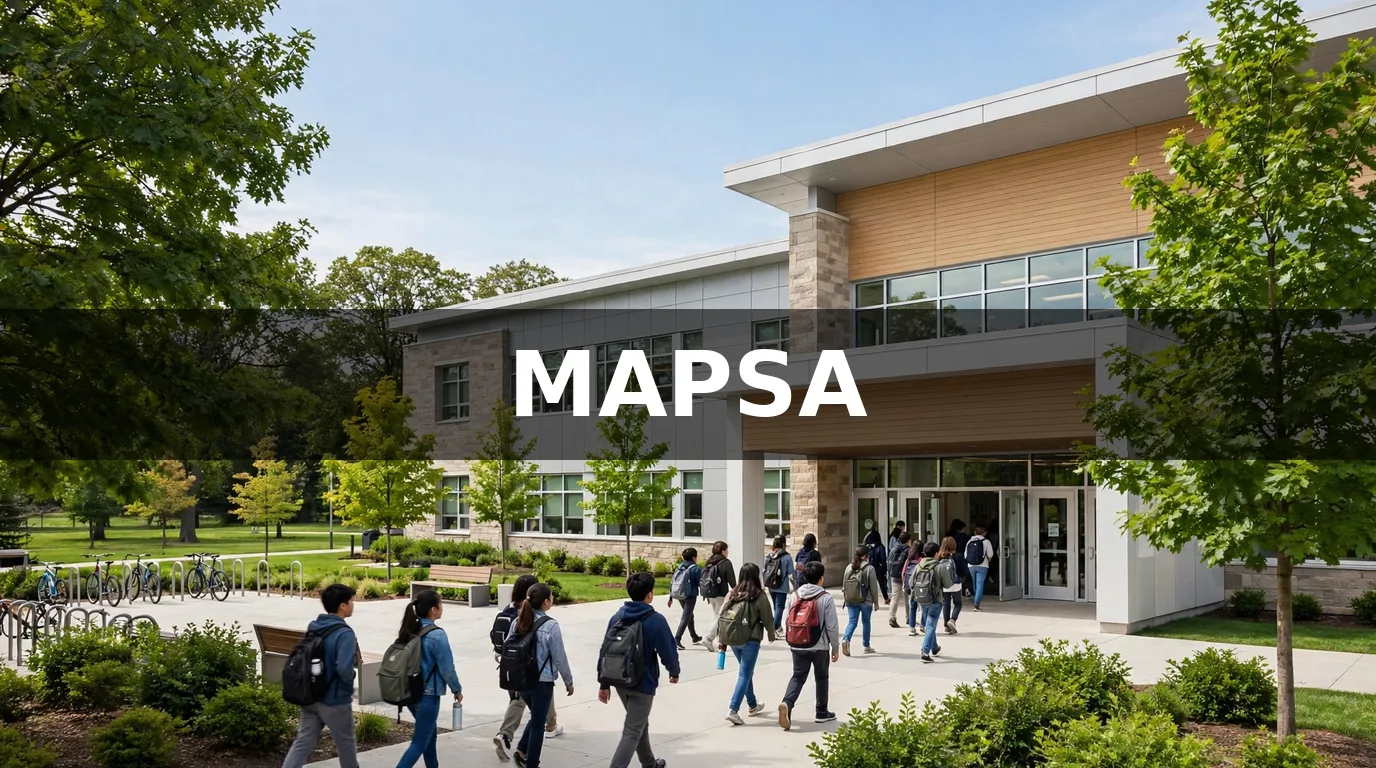
MAPSA stands for the Michigan Association of Public School Academies. It is the state charter school association for Michigan, and it speaks for the state’s charter public schools, the students who attend them, and the educators who work in them. If you have come across the name MAPSA in a discussion about Michigan education, this is almost certainly the organization being talked about.
Charter schools sit in a space that confuses a lot of people. They are public schools, open to all students and funded by public money, but they operate under a charter that gives them more freedom over how they run day to day. MAPSA exists to support those schools, defend their interests in the state capital, and help parents understand what charter schools offer. This guide explains what MAPSA is, what it does, who it represents, and how Michigan’s charter schools actually work, plus a short note on the other organizations that share the same initials.
What Does MAPSA Stand For?
MAPSA is short for the Michigan Association of Public School Academies. The name uses the formal term for charter schools in Michigan law: public school academies. Every charter school in the state is legally a public school academy, so the association’s name is simply a description of its members.
The organization describes itself as the unified voice for Michigan’s charter public school community. According to its own published material, it represents nearly 300 charter public schools, more than 150,000 students, and more than 10,000 educators across the state. It has been active for more than 25 years, supporting charter school staff, engaging parents, and giving the charter community a voice on the issues that affect Michigan schools.
What Is a Charter Public School?
To understand MAPSA, it helps to understand what a charter school is. A charter public school is a public school that operates under a contract, called a charter, with an authorizer such as a university, a community college, or a school district. The charter sets out what the school will do and holds it accountable for results.
Charter schools are free to attend, open to any student, and funded with public money, just like traditional public schools. The difference is flexibility. A charter school has more freedom over its curriculum, its staffing, and its daily schedule, and in return it faces regular review. If a charter school performs poorly over time, its authorizer can close it. That bargain, freedom in exchange for accountability, is the core idea behind the charter model.
In Michigan, charter schools serve a large share of students in cities such as Detroit, Grand Rapids, and Flint, and they include schools with a wide range of approaches, from college-preparatory academies to schools focused on arts, technology, or career training.
What Does MAPSA Do?
MAPSA’s work falls into three broad areas: advocacy, support for schools, and information for families.
Advocacy in Lansing
A large part of MAPSA’s job is advocacy. It represents charter schools before the Governor, the Michigan Legislature, and other state decision-makers, arguing that charter school students, teachers, and administrators should be treated fairly in funding and policy. Charter schools in Michigan have long argued that they receive less per-pupil funding than traditional districts, and MAPSA makes that case in the Capitol, in public debate, and in the courts when needed.
Support for schools and educators
MAPSA provides resources and backing for the people who run charter schools. That includes professional development for school leaders and teachers, guidance on state rules and compliance, and a network where schools can share what works. For a small charter school without a large central office, that kind of shared support matters.
Help for parents and families
MAPSA also works to help parents understand their options. It publishes information about how charter schools work, how enrollment operates, and what to look for when choosing a school. For families in areas where the local district school is struggling, that information can be the difference between knowing about a choice and never hearing of it.
Who Does MAPSA Represent?
MAPSA says it represents a statewide movement of charter school stakeholders. That covers several groups at once.
First, the schools themselves: nearly 300 charter public schools across Michigan, from small single-site academies to larger networks operating several campuses.
Second, the students: more than 150,000 children attend Michigan charter schools, a substantial share of the state’s public school enrollment.
Third, the educators: more than 10,000 teachers and staff work in those schools.
Fourth, the families: parents who have chosen a charter school for their children and want their choice protected in state policy.
The association is a membership body, and its work is funded by the schools and supporters in its network rather than by the state.
How Charter Schools Work in Michigan
Michigan was one of the early states to pass a charter school law, in the 1990s, and the sector has grown steadily since. Here is how the system works in practice.
A group that wants to open a charter school applies to an authorizer, most commonly a public university. The authorizer reviews the plan, and if it approves, the school opens under a charter contract that usually runs for several years. The school receives public funding based on how many students enroll, and it cannot charge tuition.
Admission is open. If more students apply than there are places, the school holds a lottery. Charter schools cannot select students by ability, and they must follow the same broad rules as other public schools on matters such as special education and non-discrimination.
Authorizers review each school’s performance and finances. A school that fails its students or mismanages money can have its charter revoked and be closed. Supporters of the model say this accountability is its strength; critics say closures disrupt families. Either way, the review process is a real part of how Michigan’s system is designed.
The History of Charter Schools in Michigan
Michigan’s charter school story began in 1993, when the state passed its first charter school law as part of a wider overhaul of school funding. The idea was new at the time: public money would follow the student, and new schools could open outside the traditional district system if they met clear standards.
Growth was slow at first. In the early years only a small number of charter schools opened, mostly in Detroit and other cities where parents were unhappy with the local district. Universities stepped in as authorizers, and the first schools were often small, single-site academies run by local groups.
The sector grew steadily through the 2000s. Detroit became the centre of the movement, and by the 2010s charter schools were educating a large share of the city’s children. The state also lifted the original cap on the number of charter schools, which had limited how fast the sector could grow. That change opened the door to larger networks operating several campuses across the state.
MAPSA grew alongside the sector. As the number of charter schools rose, the need for a single voice in Lansing grew with it. The association became the place where school leaders coordinated their message, shared legal and policy advice, and organized parents who wanted to defend their children’s schools. Today it is an established part of Michigan’s education politics, quoted in state media whenever charter policy is debated and present at every major hearing on school funding.
Why Charter Schools Are Debated in Michigan
Charter schools are a live political topic in Michigan, and MAPSA sits in the middle of that debate. Supporters argue that charter schools give families a choice when the assigned district school is not working, and that competition pushes all schools to improve. They point to charter schools that outperform their local districts and to the many families on waiting lists.
Critics argue that charter schools draw funding and students away from traditional districts, and that oversight of authorizers and school management companies has been uneven. They question whether the freedom charter schools enjoy always leads to better results.
MAPSA’s position in this debate is clear: it argues for fair treatment of charter students and for the right of families to choose. Anyone reading MAPSA’s material should know it is an advocate for the charter sector, not a neutral referee. That does not make its facts wrong, but it is worth keeping in mind when weighing the claims on either side.
How to Find a Charter School in Michigan
For a parent considering a charter school, the practical steps are straightforward. Start by listing the charter schools near your home and checking what each one offers, whether that is a particular teaching style, a focus on science or the arts, or a school culture that fits your child. Visit the schools, talk to teachers and parents, and ask about class sizes, results, and how the school supports students who need extra help.
Enrollment usually opens well before the school year starts, and popular schools fill up, so applying early matters. If a school has more applicants than places, admission is decided by lottery, so there is no advantage in trying to game the process. MAPSA’s own website and the websites of individual schools publish enrollment information, open-house dates, and contact details.
Other Organizations Called MAPSA
MAPSA is not a unique name, and the same initials belong to several other organizations around the world. Knowing the difference saves confusion.
In the United Kingdom, MAPSA is the Members’ and Peers’ Staff Association, a cross-party organization run by and for the staff of Members of Parliament and peers in the House of Lords.
In Malaysia, MAPSA is the Malaysian Association of Professional Secretaries and Administrators, a professional association for office administrative professionals founded in 1968.
In the Philippines, the Manila Archdiocesan Parochial Schools Association, later renamed the Manila Ecclesiastical Province School Systems Association, used the name MAPSA for decades.
In South Africa, MAPSA is the Modern Art Project South Africa, a registered non-profit that promotes contemporary art in the Karoo town of Richmond.
In the United States, the Midwest Automotive Parts and Service Association also used the name MAPSA, and Microsoft once sold a tool called the Microsoft Assessment and Planning Solution Accelerator, shortened to MAPSA. None of these is connected to the Michigan association. When someone in an American education context says MAPSA, they mean the Michigan charter school association.
Frequently Asked Questions
What does MAPSA stand for?
MAPSA stands for the Michigan Association of Public School Academies. It is Michigan’s charter school association, representing the state’s charter public schools, their students, and their educators.
How many charter schools does MAPSA represent?
MAPSA represents nearly 300 charter public schools in Michigan, serving more than 150,000 students and employing more than 10,000 educators, according to the association’s own published figures.
Is a charter school a private school?
No. Charter schools in Michigan are public schools. They are free to attend, open to all students, funded with public money, and held accountable by their authorizer. They are sometimes called public school academies in Michigan law.
How do students get into a Michigan charter school?
Admission is open to any student. If more students apply than there are places, the school holds a lottery. Charter schools cannot charge tuition or select students by academic ability.
How long has MAPSA been around?
MAPSA has been active for more than 25 years, supporting Michigan’s charter school community since the early years of the state’s charter school law.
Is MAPSA part of the Michigan government?
No. MAPSA is an independent association funded by its members and supporters. It advocates to the state government on behalf of charter schools, but it is not a government agency.
Conclusion
MAPSA is the Michigan Association of Public School Academies, the association that speaks for Michigan’s charter public schools. It represents nearly 300 schools, more than 150,000 students, and more than 10,000 educators, and it has been part of the state’s education landscape for more than 25 years. Its work is advocacy in Lansing, support for schools and teachers, and information for parents weighing their options.
For families, the useful takeaway is practical: charter schools are free, public, and open to all, and MAPSA is the organization that defends that choice in state policy. For anyone who meets the name in another context, a quick check is worthwhile, because the same initials belong to staff associations, professional bodies, and arts organizations in other countries. In Michigan education, though, MAPSA means one thing: the voice of the state’s charter public schools.
Read Also: Independent Sales Organization: How ISOs Work in 2026


1 response