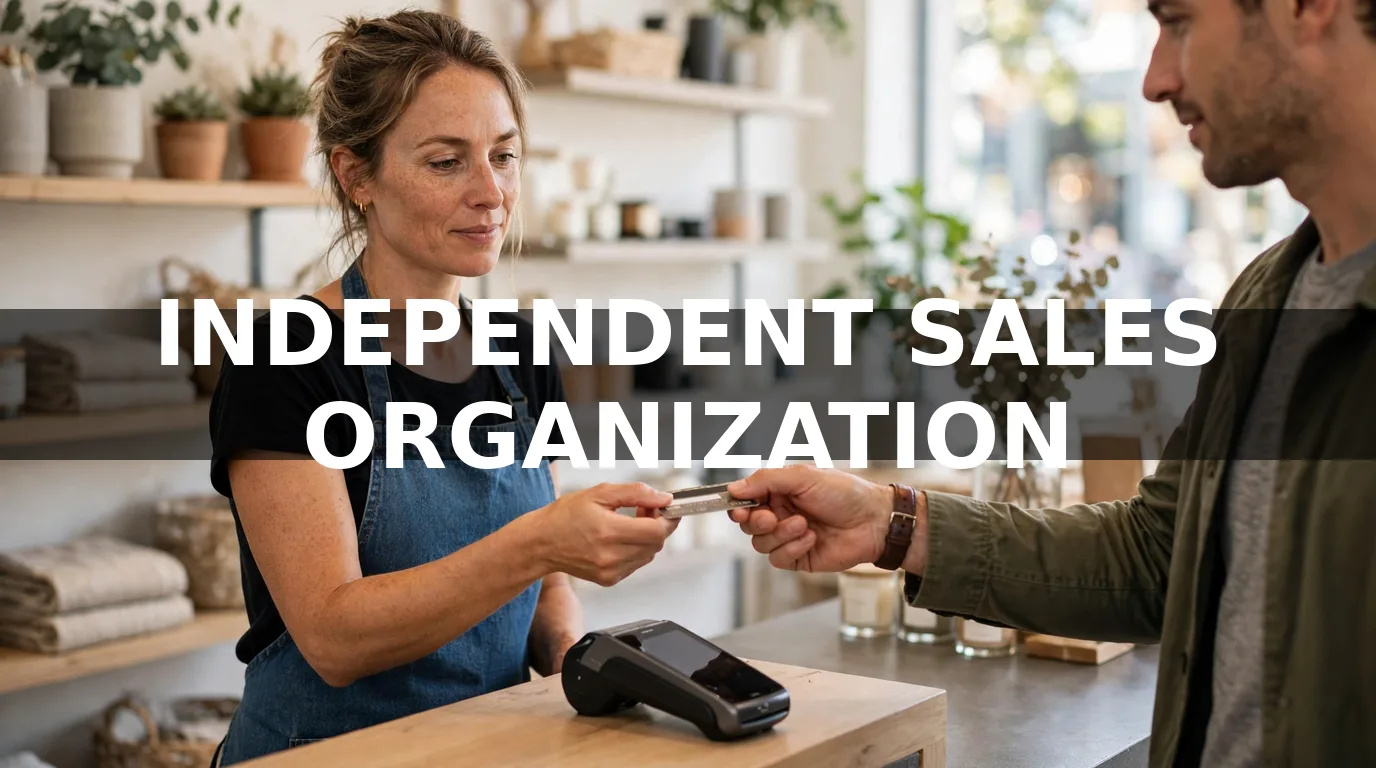
An independent sales organization, usually shortened to ISO, is a third-party company that signs businesses up for card payment processing on behalf of a bank. Every time a shop, restaurant, or online store takes a credit or debit card, a chain of companies sits behind that single tap or swipe. The ISO is the part of the chain a business owner actually meets: it sells the service, sets up the account, supplies the terminal, and answers the phone when something goes wrong.
ISOs matter because a business cannot simply start accepting cards on its own. Card payments have to be backed by a bank that belongs to Visa and Mastercard. Most small and mid-sized businesses never deal with that bank directly. Instead, they deal with an ISO that works under the bank’s umbrella. This guide explains what an independent sales organization is, how one works day to day, how it earns its money, how it differs from a payment processor and a sales agent, and what to check before signing a contract with one.
What Is an Independent Sales Organization?
An independent sales organization is a company authorized to market and sell credit card processing services for banks and card companies. It acts as an intermediary between the financial institutions that move money and the businesses that need to accept electronic payments.
The word “independent” can be misleading. An ISO is independent in the sense that it is a separate company from the bank, with its own sales team, pricing, and brand. It is not independent in the sense of working alone. Every ISO must be sponsored by an acquiring bank, which is a bank registered with Visa and Mastercard. The sponsoring bank registers the ISO with the card networks before the ISO does any work, and the bank carries the ultimate responsibility for the merchant accounts the ISO signs.
Visa calls these companies independent sales organizations in its own classification system. Mastercard uses the term member service provider, or MSP, for the same kind of organization. In practice the two terms describe the same role, and many companies use them interchangeably.
How an Independent Sales Organization Works
The work of an ISO follows a clear sequence, from the first sales call to the day-to-day support of a live merchant account.
Finding and signing merchants
An ISO’s sales team looks for businesses that need to accept card payments: new shops opening their doors, restaurants switching providers, and online sellers adding checkout. The ISO explains its pricing and equipment, and if the business agrees, it collects an application with details about what the business sells, its expected sales volume, and its ownership.
Underwriting the application
The application is reviewed in a step called underwriting. The ISO checks what the business sells, its trading history, and the risk that it will generate chargebacks or fraud. This review happens under the sponsoring bank’s policy, and the bank has the final say on whether the account is approved. High-risk trades, such as travel or subscription businesses, face closer checks and sometimes higher fees.
Setting up the merchant account
Once approved, the business gets a merchant account. This is a special type of account that lets a business accept card payments and receive the money from those sales. The ISO configures the account, supplies the card terminal or point-of-sale system, and connects the payment gateway if the business sells online.
Processing payments
When a customer pays by card, the ISO does not move the money itself. The payment travels from the card terminal through the payment processor to the acquiring bank, which settles the funds into the merchant’s bank account. The ISO’s job is everything on the merchant’s side of that chain: the sale, the equipment, the setup, and the support after the first transaction.
Ongoing support and risk monitoring
After the account is live, the ISO answers support calls, replaces faulty terminals, and watches for unusual activity. If a merchant starts generating a high level of chargebacks, the ISO steps in, because under its contract with the bank, the ISO usually covers losses when a merchant cannot pay.
ISO vs Payment Processor: What Is the Difference?
People often use the two terms as if they mean the same thing. They do not.
A payment processor is the technology company that moves transaction data between the merchant, the card networks, and the banks. It authorizes the card, routes the payment, and settles the funds. A processor is largely invisible to the business owner.
An ISO is the sales and service company. It finds the merchant, signs the contract, sets the pricing, provides the equipment, and handles support. The ISO works with a processor behind the scenes, and in some cases an ISO also owns or operates processing technology, but the roles are distinct: the processor moves the money, the ISO manages the relationship.
A simple way to remember it is that the ISO is the company a business owner talks to, while the processor is the system that does the moving.
ISO vs MSP vs Agent vs Referral Partner
The payments industry has several middleman roles, and the differences come down to how much selling the company does, how much risk it takes, and how it gets paid.
An ISO holds the relationship with the sponsoring bank, signs merchants in its own name, sets pricing, and takes on liability for merchant losses. It keeps the margin between what the merchant pays and what the processing actually costs.
A member service provider, or MSP, is the Mastercard name for the same role. Visa says ISO, Mastercard says MSP, and the work is the same.
A sales agent works for an ISO or a processor. Agents find merchants and hand them over, but they do not hold the bank relationship, set pricing, or carry liability. They are usually paid a commission or a share of the ongoing revenue from the accounts they bring in.
A referral partner simply points a business toward a provider and takes a one-off referral fee. Referral partners do no underwriting, supply no equipment, and provide no support.
The key point for a business owner is that an ISO is the party responsible for the account. An agent or referral partner is not.
What Services Does an ISO Provide?
An ISO’s services go well beyond signing a contract. The typical package includes:
Merchant account setup. The ISO handles the application, the underwriting checks, and the activation of the account, so the business can start taking cards quickly.
Card terminals and point-of-sale systems. The ISO supplies and configures countertop terminals, mobile card readers, and full point-of-sale systems, and shows staff how to use them.
Online payment gateways. For businesses that sell on the web, the ISO connects a payment gateway that lets customers pay by card at checkout.
Pricing and billing. The ISO sets the merchant’s pricing plan and sends the monthly statement showing fees and transaction volumes.
Chargeback handling. When a customer disputes a payment, the ISO helps the merchant gather evidence and respond within the card network’s deadlines.
Ongoing support. Terminal faults, settlement questions, and account changes all go through the ISO’s support team rather than the bank.
Some ISOs also offer extras such as gift card programs, loyalty tools, cash advance products, and reporting dashboards. These vary widely, so they are worth asking about rather than assuming.
How Do ISOs Make Money?
An ISO earns money from the margin between what the merchant pays and what the ISO pays the bank and the processor. The two most common pricing models are interchange-plus and flat rate.
With interchange-plus pricing, the merchant pays the wholesale interchange fee set by the card networks, plus a fixed markup that goes to the ISO. This model is transparent, because the merchant can see exactly what the markup is.
With flat-rate pricing, the merchant pays a single percentage on every transaction, whatever card the customer uses. This is simple to understand, but it can be expensive for businesses that take a lot of debit cards or low-cost transactions, because the same rate applies to cheap and expensive cards alike.
On top of transaction fees, some ISOs charge monthly fees, terminal rental, PCI compliance fees, and statement fees. The ongoing share of transaction revenue that an ISO earns from its portfolio of merchants is called its residual income, and it is the main reason building a portfolio of merchants is a valuable business.
How to Choose an Independent Sales Organization
Choosing an ISO is a decision that affects what a business pays on every sale for years, so it deserves more than a quick look at the headline rate. These checks help.
Ask who the sponsoring bank is. A legitimate ISO will name its sponsoring bank without hesitation. If a company cannot or will not say which bank stands behind it, walk away.
Read the contract term and the exit fee. Some ISO contracts run for three years and charge a large fee for leaving early. A month-to-month agreement, or a short term with a clear exit fee, is safer.
Get the full fee list in writing. Ask for every fee, not just the transaction rate: monthly fees, PCI fees, terminal rental, chargeback fees, and the fee for closing the account. Compare the total, not the headline percentage.
Check whether the terminal is leased or bought. Terminal leases are a common trap. A terminal that costs a few hundred dollars to buy can cost thousands over a long lease. Buying outright is almost always cheaper.
Test the support. Call the support line before signing. If it is hard to reach a person now, it will be harder when a terminal stops working on a busy Saturday.
Look for honest pricing language. Be cautious of “free terminal” offers tied to long contracts, rates quoted without the interchange cost, and promises of a fixed rate that the small print can change.
Red Flags to Watch For
A few warning signs come up again and again in complaints about ISOs. A contract that is hard to cancel, fees that appear on the first statement that were never mentioned, a terminal lease that costs far more than the hardware, and a sales representative who will not put the rate in writing are all reasons to pause. Another red flag is pressure to sign on the spot. A genuine ISO expects a business owner to read the agreement and compare it with others.
How to Become an Independent Sales Organization
Becoming an ISO is a bigger step than becoming a sales agent, because the ISO takes on the bank relationship and the liability. The usual path is to find a sponsoring acquiring bank willing to back the business, register with Visa and Mastercard through that bank, and meet the networks’ financial, compliance, and operational standards. Registration fees apply: figures published by industry sources put the first-year registration at around $10,000 for a single processor relationship, then around $5,000 in each following year per card association. The ISO must also show it has the capital to cover merchant losses, the systems to monitor risk, and the staff to support merchants. Most people enter the industry first as an agent, build a portfolio of merchants, and only then move up to ISO status.
Frequently Asked Questions
Is an independent sales organization the same as a payment processor?
No. An ISO sells and manages merchant accounts on behalf of a bank, while a payment processor is the technology that moves transaction data and settles funds. The ISO is the company the merchant deals with; the processor works behind the scenes.
Does an ISO need a bank?
Yes. Every ISO must be sponsored by an acquiring bank that is a member of Visa and Mastercard. Without a sponsoring bank, a company cannot offer merchant processing services, and the bank carries the ultimate liability for the merchants the ISO signs.
What is the difference between an ISO and an MSP?
There is no practical difference. Visa calls these companies independent sales organizations, while Mastercard calls them member service providers. Both terms describe a company registered with a sponsoring bank to sell merchant services.
How does an ISO earn money?
An ISO earns the margin between what the merchant pays in processing fees and what the ISO pays the bank and processor. It also earns ongoing residual income from its portfolio of merchants, plus any monthly or service fees in the contract.
Is it safe to use an ISO for card payments?
Using a registered ISO sponsored by a known acquiring bank is a normal and safe way for a business to accept cards. The risk comes from signing a bad contract, so check the sponsoring bank, read the full fee list, and avoid long terminal leases.
Can a small business work directly with a bank instead of an ISO?
Some banks offer merchant accounts directly, but most small businesses find the bank’s process slower and the support less hands-on. An ISO usually offers faster setup, equipment, and day-to-day support, which is why most small merchants go through one.
Conclusion
An independent sales organization is the company that connects a business to the card payment system. It works under a sponsoring bank, signs merchants, sets their pricing, supplies their equipment, and supports them after the first sale. It is not the same as a payment processor, which moves the money, or a sales agent, who only finds merchants and takes a commission.
For a business owner, the practical lesson is simple: the ISO you choose decides what you pay on every card sale and how much help you get when something breaks. Check the sponsoring bank, read every fee in the contract, avoid expensive terminal leases, and test the support before signing. Get those checks right, and an ISO becomes a useful partner rather than a costly mistake.
Read Also: Price of Tickets for World Cup 2026: Complete Guide



1 response